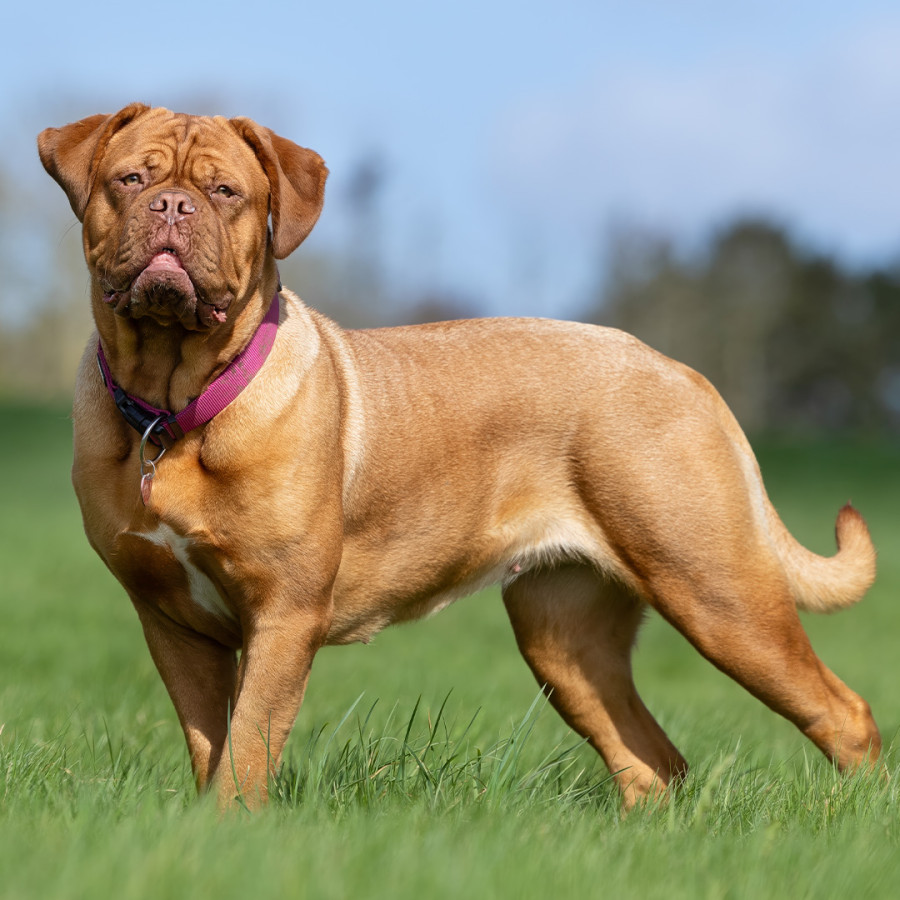
Dogue de Bordeaux Dog Breed
The Dogue de Bordeaux (also known as the French Mastiff) is a large, powerful breed with so much affection for their family. They're not the ideal breed for first-time dog owners because of their size and strength.
The Dogue de Bordeaux (also known as the French Mastiff) is a large, powerful breed with so much affection for their family. They're not the ideal breed for first-time dog owners because of their size and strength.
The Dogue de Bordeaux need confident, consistent handling from an early age. They're bursting with character: a bit of drool, some dramatic snoring, and a devoted, larger-than-life presence in the home. Prospective owners should be prepared for a shorter-than-average lifespan.
The Dogue de Bordeaux is an affectionate, calm breed that is devoted to their family.
Despite their imposing size and serious expression, they are typically gentle and soft-natured at home. They just want to be as physically close to the people they love as possible.
They mature slowly, both physically and mentally, maintaining a playful, puppy streak well into adulthood.
Their protective instincts run deep, and they can be cautious or watchful around strangers, though aggression is not typical of a well-socialised dog.
Early socialisation and handling with confidence is essential for this breed – their sheer size means even well-meaning behaviour, like jumping up, can become difficult to manage if not addressed early.
Disclaimer
While these breed traits give a general idea of what to expect from a specific type of dog, it's important to remember that every dog is unique. Just like people, each dog comes with their own distinct personality, quirks, and characteristics!
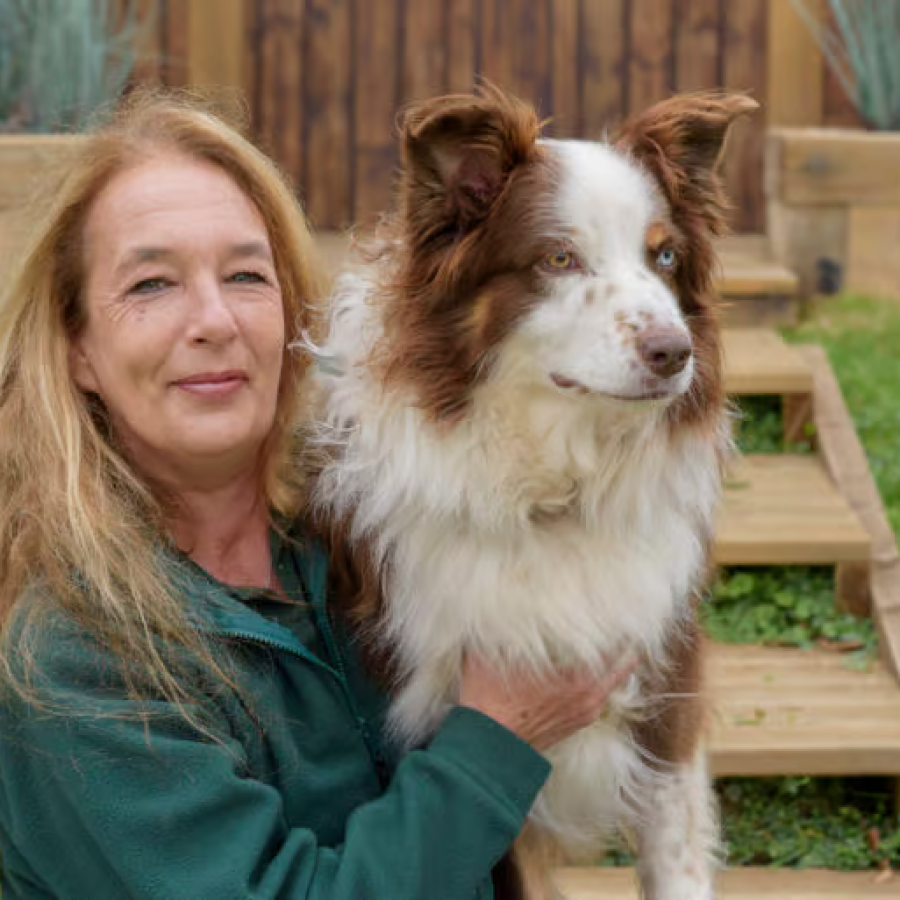
Dogue de Bordeaux can make affectionate family dogs in the right home.
They can be calm and gentle with the children they know well, but due to their size, an adult should always supervise closely, especially around young or unfamiliar children. Even friendly, innocent enthusiasm from a dog of this size can knock a child over.
This breed is naturally protective, and they will step in if they sense the children in their own household are under threat. Supervision is essential when kids are scuffling or playing boisterously when friends are round.
This breed is best suited to experienced owners with the time, space and confidence to manage a large, strong-willed dog. They do not cope well with being left alone for long periods.
Dogue de Bordeaux need space. A large home with a securely fenced garden is strongly recommended, both for their size and because they are known to be surprisingly capable jumpers.
Due to their size and strength, they are not suited to apartment living or homes with limited outdoor access.
They can live with other dogs and pets when introduced thoughtfully, though their size means careful management is needed around smaller animals.
Males in particular can be intolerant of other male dogs, so this is worth bearing in mind when considering a multi-dog household.
They suit calm, experienced households with someone usually at home. If you're exploring which breed best suits your home and lifestyle, try the Discover the Right Dog for Me quiz to find your match.
Dogue de Bordeaux often want to be as physically close to their owners as possible, regardless of their own considerable size. Many enjoy leaning loving against or resting their head on the people they're attached to - so be prepared for a drooly cuddle or two.
They can be reserved with strangers initially, taking time to decide whether someone is worth their trust.
Their devotion to their family means they can experience separation-related issues if left alone too often or for too long.
Despite their serious expression and powerful build, the Dogue de Bordeaux is a playful breed with a cheeky puppyish character which stays with them into adulthood.
They enjoy short bursts of activity throughout the day, and their play style tends to be scatty and uncoordinated, especially when they’re young.
As this breed of dog grows quickly, playtime should be gentle. Their developing joints need protecting from any impact, ideally until 18 months of age.
Dogue de Bordeaux will often bark to alert their owners to visitors or anything unusual happening near the home, in keeping with their history as guardian dogs.
Generally, they don't bark excessively for no reason, it would be in response to any unusual activity and to alert their owners.
With consistent training and socialisation from an early age, barking can be well managed.
Their imposing size alone is usually enough to give visitors pause, regardless of how vocal they are.
Any breed can develop behavioural issues, especially if their needs are not met. For the Dogue de Bordeaux, early training is important.
A fully grown Dogue that jumps up or pulls on the lead can be tricky to manage safely.
This breed love being in the company of their owners and really struggle when left alone. This can lead to separation-related issues.
With a protective nature, this breed needs socialisation from a young age to help build their confidence, especially around unfamiliar people or dogs. Consistent, positive training is key to helping a dog with these tendencies.
Originally bred to guard estates and hunt large game, the Dogue de Bordeaux is a powerful breed but not a high-energy one. Around an hour of exercise a day, ideally split across two walks, suits most adult Dogues well.
Puppies and young dogs should not be over-exercised because their bones and joints develop slowly, and excessive jumping, running or stair use before they are fully grown can cause lasting damage. Like all dogs, they benefit from regular access to green space for sniffing and gentle movement.
Dogue de Bordeaux are intelligent and generally eager to please, but they can be strong-willed, so confident, consistent training is essential from day one.
Positive, reward-based methods work well with this breed. Training must begin as early as possible – a Dogue that reaches full size without basic manners becomes very tricky to manage. This breed is not generally recommended for first-time owners for this reason.
Adolescence often brings renewed testing of boundaries, so consistent reinforcement throughout the first two years is essential.
Five common behavioural issues to watch out for:
• Jumping up – enthusiastic greetings from a dog this size can be dangerous and need addressing early.
• Pulling on the lead, which becomes a significant safety issue given their strength.
• Separation-related distress if left alone without a gradual, positive introduction to alone time.
• Wariness around unfamiliar people or dogs if socialisation is lacking.
• Resource guarding, which can develop in any breed without early, positive handling around food and toys.
The Dogue de Bordeaux has a short, smooth coat that is relatively easy to maintain. Weekly brushing helps to manage shedding and keep the coat in good condition.
Far more important is the care of their facial wrinkles and skin folds, which should be cleaned and dried regularly to prevent skin irritation and infection.
This breed is also known for drooling, particularly after eating or drinking, so regular face cleaning is part of daily life.
Nails should be trimmed monthly and ears checked regularly. Getting puppies comfortable with handling and grooming early makes the process much easier as they grow.
A nutritious diet, careful management of exercise during growth, and regular vet check-ups all help to reduce the risk of health problems and support a good quality of life.
Responsible breeders carry out health tests on their breeding dogs – always ask for evidence before taking on a puppy. Conditions this breed can be predisposed to include:
• Hip and elbow dysplasia – abnormal joint development that can lead to pain and arthritis. The BVA/Kennel Club Hip Dysplasia Scheme is available for screening.
• Gastric dilatation-volvulus (GDV/bloat) – a life-threatening emergency where the stomach fills with gas and can twist. Immediate veterinary attention is required.
• Dilated cardiomyopathy (DCM) – a heart condition in which the heart muscle weakens and loses its ability to pump blood effectively.
• Entropion and ectropion – eyelid conditions where the lid rolls inward or outward, both of which can cause irritation and may need surgical correction.
• Skin fold dermatitis – the breed’s deep facial wrinkles can trap moisture and bacteria, leading to recurring skin infections without regular cleaning.
• Cancer – as with many giant breeds, Dogues de Bordeaux have a higher-than-average risk of developing cancers, including osteosarcoma (bone cancer) and lymphoma. Their relatively short lifespan is often linked to this increased cancer risk, so owners should stay alert to unusual lumps, swelling, lethargy, or weight loss and seek prompt veterinary advice.
I need around an hour of gentle exercise each day. Please don’t let me overdo it while I’m young – my joints are still growing and need protecting from too much impact.
I’m calm but I still appreciate things to do! Short training sessions, gentle games and sniffing walks all help keep me content. I genuinely enjoy spending time with my family.
Please start training me early – I grow fast and a giant dog with no manners is hard to manage! I respond best to confident, calm and consistent guidance.
Buying a Dogue de Bordeaux puppy from a responsible breeder in the UK typically costs between £1,500 and £3,000. Rehoming from a rescue is usually around £150–£250. We’d always encourage you to explore dogs available through Woodgreen or other reputable rescues first.
Start-up costs for giant-breed-sized essentials typically come to around £400–£600.
Ongoing monthly costs include food (£80–£110 due to their size), insurance (£70–£120 – the Dogue de Bordeaux is one of the more expensive breeds to insure given their known health predispositions), and routine vet care including vaccinations, boosters and parasite control.
Total estimated monthly cost: £170–£270.
Take our quiz to discover which breed is right for you
Take our quizPlease call our pet support line on 0300 303 9333 (7 days a week – 8.30am - 4pm)